
Gas Nitriding
What is Gas Nitriding?
Gas nitriding is a traditional surface hardening method performed at relatively low temperatures, typically between 500°C and 550°C, which is below the A1 transformation point (~725°C) of steel. During the process, ammonia gas (NH₃) dissociates according to the reaction 2NH₃ ↔ 3H₂ + 2[N], and the active nitrogen atoms chemically react with alloying elements in the steel such as Fe, Al, Cr, Mo, and Ti to form nitrides.
These nitrides exhibit very high hardness, as well as excellent fatigue strength, wear resistance, corrosion resistance, and oxidation resistance. Because gas nitriding is carried out at lower temperatures compared to conventional heat treatment processes, it produces minimal distortion, making it ideal for precision components.
Key Advantages of Gas Nitriding


Long-Term Dimensional Stability : Maintains high precision over extended use.
Excellent Wear, Corrosion, and Fatigue Resistance : Enhances durability under mechanical and chemical stress.
Superior Heat Resistance : Performs reliably at elevated temperatures.
Minimal Deformation : Low-temperature process minimizes dimensional distortion.
Thick and Strong Hardened Layer : Forms a deep, robust nitrided case for enhanced surface strength.
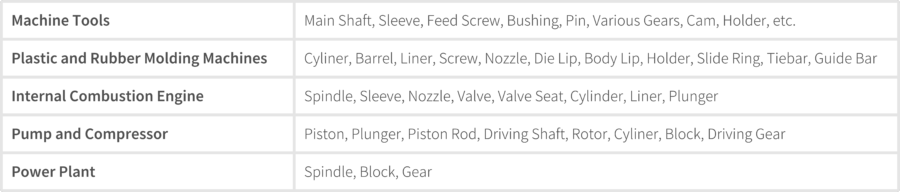
Components Treated by Gas Nitriding